


Battery tester with Rel/Rct diagnostics
The TMC-2001RTS is a professional battery tester for stationary battery systems. It combines fast voltage measurement, internal resistance measurement, Rel/Rct diagnostics, RFID assignment and CS-Manager documentation in one mobile system.
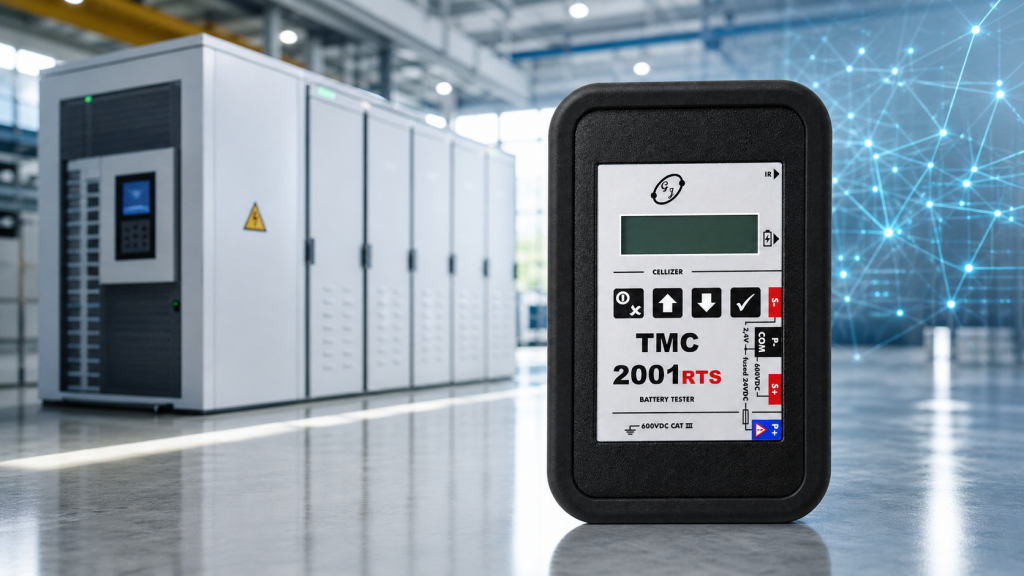
- For: UPS maintenance, stationary battery systems, industrial batteries and recurring service assignments.
- Measures: Block voltage, Rel, Rct, temperature, electrolyte density, total battery voltage and battery current.
- Documentation: Measured values, limit values, reports and maintenance history via the CS-Manager software.
Key benefits at a glance
Rel and Rct diagnostics
The battery tester evaluates electrical and electrochemical changes separately. This provides a significantly more differentiated picture of battery condition than a pure 1000 Hz analysis.
Fast measurement acquisition
Block voltage, Rel and Rct are acquired in a single measurement step. For pure block voltage measurements, acquisition is particularly fast and therefore practical even for large systems.
Guided service procedures
Menu-guided measurement functions, acoustic confirmation, remeasurement options and clear measured-value displays support reproducible testing directly at the battery system.
RFID, memory and CS-Manager
RFID assignment, large measured-value memory and up to 1,000 transferable battery definitions link mobile measurement with well-prepared and documented maintenance.
More diagnostic information than a pure 1000 Hz internal resistance measurement
The Rel measurement covers the proven method for determining ohmic internal resistance. In addition, the TMC-2001RTS determines the charge-transfer resistance Rct, making electrochemical abnormalities visible that may remain hidden in a purely electrical assessment.
Rel · electrical resistance
Rel describes the electrical, ohmic component of internal resistance. It helps evaluate losses at terminals, intercell connectors, grids and in the electrolyte.
Rct · charge-transfer resistance
Rct describes charge transfer at the interface between electrode and electrolyte. It adds an electrochemical diagnostic level to classic resistance measurement.
The TMC-2001RTS measurement method
The instrument works with a controlled current profile. Internal resistance values are calculated from the current profile and the resulting voltage response. Several synchronous A/D converters and digital filtering support fast and reproducible measurements.
Controlled current change
During testing, a defined current change can be generated. The resulting voltage response forms the basis for resistance diagnostics.
Synchronous A/D converters and digital filtering
The measurement architecture supports high-resolution acquisition of voltage and current profiles and ensures comparable results in recurring test procedures.
Robust in industrial environments
The continuous resistance measuring range up to 1.3 Ω helps maintain stable, practical measurements even under more demanding system conditions.
For recurring maintenance and capacity tests
Depending on the task, measurement functions are available for individual measurements, float operation, discharge, charge, resistance, temperature, electrolyte density and interval recordings.
Float operation
Schnelle Aufnahme aller Blockspannungen während der Float operation.
Discharge and charge
Repeated measurement of block voltages during discharge or charging, for example during capacity tests.
Resistance measurement
Acquisition of block voltage, Rel and Rct for all blocks in a battery system.
Temperature and density
Optional sensors can integrate block temperatures as well as electrolyte density (DMA35 v3) and temperature values into the maintenance process.
Interval U and Interval U+I
Recording of total battery voltage and, optionally, voltage and current over freely definable time intervals.
Guided test procedure directly on the instrument
On site, the TMC-2001RTS supports the user with clear measurement functions and traceable measured-value displays. This reduces measurement errors and simplifies work on large systems.
01 · Select measurement function
For example float operation, discharge, resistance or interval measurement.
02 · Acquire measured values
Place the Kelvin test probes, trigger the measurement and receive acoustic confirmation of successful acquisition.
03 · Check and remeasure
Measurement series can be reviewed directly on the instrument. Individual blocks can be remeasured selectively if required.
Battery definitions, limit values and RFID assignment
Battery systems can be prepared in CS-Manager and then transferred to the TMC-2001RTS. This ensures that the correct battery definitions, number of blocks and limit values are available on site.

The integrated RFID function supports clear assignment of a battery system. A system can be identified by transponder and linked to the matching battery definition. This reduces the risk of mix-ups during recurring tests.
CS-Manager: from measured value to maintenance record
Together with the CS-Manager software, a complete workflow is created: define batteries, prepare maintenance routes, import measurement data, evaluate trends and generate reports. The software can be used locally or centrally with an SQL/Firebird database.
Manage sites and battery systems
Sites, groups, strings, block types and battery systems are structured clearly and remain traceable over the long term.
Prepare routes and tester transfer
Relevant battery definitions can be filtered and transferred specifically to the TMC-2001RTS.
Analysis, history and reports
Measurement series can be evaluated in tables, charts and histories. Reports and CSV export complete the maintenance process in a traceable way.
Designed for mobile service use
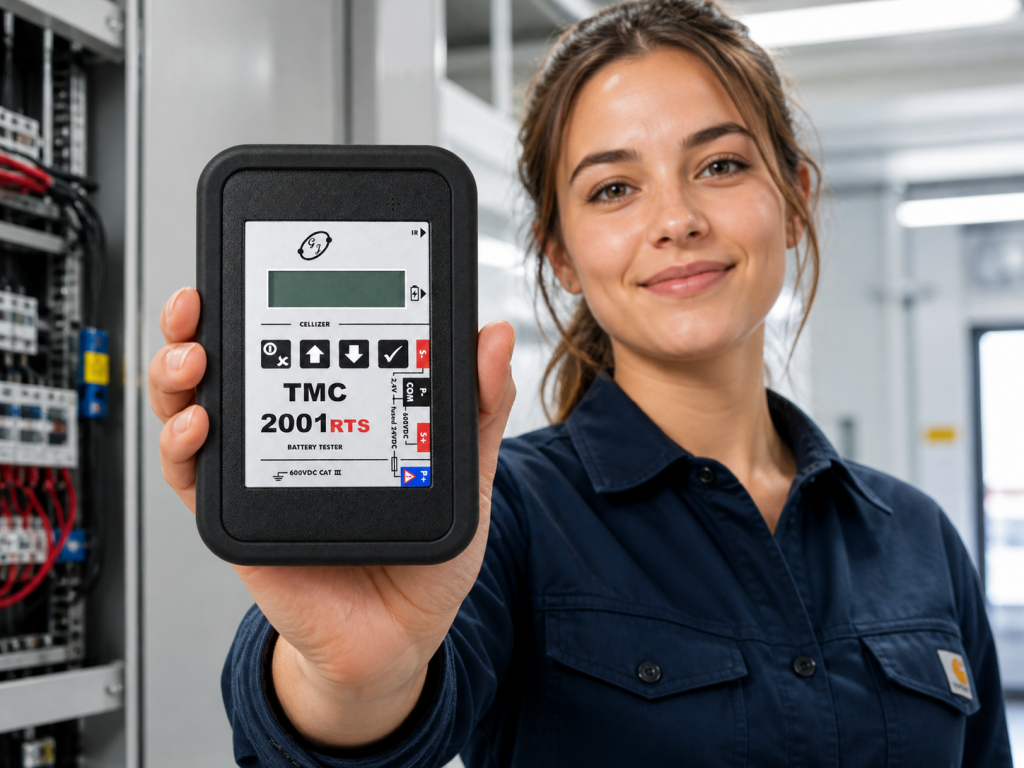
The instrument is compact, portable and designed for work directly at battery systems. The backlit display, menu-guided operation and robust protective cover support practical use on site.
Bluetooth and IrDA are available for data transfer. This allows the TMC-2001RTS to be used flexibly as well as in environments where radio communication is restricted.
Technical specifications
| Instrument type | Mobile battery tester for stationary battery systems |
| Resistance diagnostics | Electrical resistance Rel and charge-transfer resistance Rct |
| Measuring time | Block voltage approx. 0.9 s; block voltage + Rel + Rct approx. 2 s |
| DC measuring ranges | Block voltage ±2.45 VDC and ±24.5 VDC; total voltage ±600 VDC |
| Resistance measuring range | Up to 1.3 Ω, resolution 10 µΩ |
| Safety category | 600 V CAT III |
| Memory | Up to 300,000 measured values |
| Battery definitions | Up to 1,000 transferable from the database |
| Interfaces | Bluetooth, IrDA and RFID system |
| Density meter | Direct connection of a DMA35(v3) possible |
| Operating time | Up to 10 hours with fully charged system |
| Software | CS-Manager battery management software |
| Dimensions | approx. 154 mm × 98 mm × 33 mm |
Scope of delivery and optional accessories
Scope of delivery depending on article number
TMC-2001RTS test instrument, battery charger, CS-Manager software as download, transport case and, depending on the version, no Kelvin test probes, straight Kelvin test probes or right-angle Kelvin test probes, with or without protector.
Optional accessories
RFID transponder tags, temperature sensor, DMA35 density meter, straight or right-angle Kelvin test probes, current clamp for Interval U+I and IR communication adapter.
Frequently asked questions about the TMC-2001RTS
What is the difference between Rel and Rct?
Rel describes the electrical, ohmic component of internal resistance. Rct describes charge transfer at the interface between electrode and electrolyte. Together, both values provide a more differentiated picture of battery condition.
Can the TMC-2001RTS be used for capacity tests?
Yes. For capacity tests and discharge tests, the device can assist by taking interval measurements of the total battery voltage and current, when used with a current clamp. There are also special functions for recording all block voltages multiple times during a test.
Are measured values stored automatically?
Yes. Measured values are stored in the instrument and can then be transferred to the CS-Manager software.
Is data transfer without wireless communication possible?
Yes. In addition to Bluetooth, data transfer can be carried out via IrDA if wireless communication is not desired or not permitted.
Downloads and further information
All important documents, detailed information and contact options remain directly accessible.